
No one should be surprised to see the headlines this week on the “dire” rental affordability situation which is not just about renters rights. While news stories will have you thinking the entire Melbourne rental market is a tale of doom and gloom, the reality is more nuanced.
Nevertheless, the latest Rental Affordability Index should ring alarm bells for the Victorian Government and what they are doing to lower-income renters particularly. They may think they are helping renters, but unfortunately they are not.
As opined upon many times here, the additional costs (hard and soft) on owners has reduced the rental pool and pushed up rents. But is there really a rental shortage?
In the Melbourne CBD (Postcode 3000) there are 3,660 properties advertised for rent.
In Truganina there are 1,190
Camberwell has 610 properties for rent
Bentleigh has 296
Thornbury has 532
Frankston has 228
In fact across Victoria there are 19,184 properties for rent.
So do we really have a rental crisis or is there something else going on?
Different suburbs and property categories have their own rhythm and dynamic. Knowing where to look and what to look for makes all the difference.
Investment owners are not going to run their property at a loss. Similarly if they ask too much and overshoot the rental market their property sits empty with no income. Owners need the rent to cover the extra cost of land tax, compliance costs, higher risk of rental voids and unrecoverable tenant damage, plus interest costs. They all add up. On the other hand renters are getting squeezed by increases in cost of living and can only pay so much.
So there is now a fascinating balancing act playing out behind the scenes. On one hand, we see affordability challenges hitting certain groups hard, particularly those on lower incomes. They’re the ones who are often spending well over 30% of the income threshold on rent, and doing it really tough. On the other hand, not every corner of the market is equally tight.
As the rental rules tighten further to support renter rights, owners and agents are being increasingly careful about who they rent a property to in the first place. Tenant selection feels like the last opportunity for an owner and agent to exercise some control before a tenant moves in and the rules take over. Tenants need to work hard on putting in a great application.
With tenancy laws becoming more tenant friendly, landlords and agents have grown more selective. They know their main point of control is when selecting the right tenant for them and their property. Find a good tenant who is house proud and can afford a fair rent. Once a tenant is in, they are at the behest of the rental rules. It is no surprise landlords are being extra careful, favouring tenants who can comfortably afford the rent and have stellar references.
This selectiveness means that while some lower income renters are really struggling, there are still mid-to-upper market properties lingering a little longer on the market. It’s not a universal frenzy everywhere.
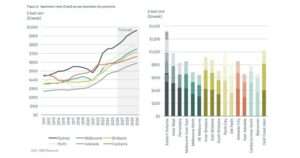
The recent research completed by SGS Economics shows Melbourne’s rental affordability has stabilised. The research shows the median rent is $570/wk and comprises 25% of the median renting household income of $116,640. This is up slightly from 23% in 2019.
The below table shows the rental affordability index and severity of rental unaffordability.
| Index score | Income on rent | Relative unaffordability |
| <40 | 75% or more | Critically unaffordable |
| 41-60 | 60-75% | Extremely unaffordable |
| 61-80 | 38-60% | Severely unaffordable |
| 81-100 | 30-38% | Unaffordable |
| 101-120 | 25-30% | Moderately unaffordable |
| 121-150 | 20-25% | Acceptable |
| 151-200 | 15-20% | Affordable |
| >200 | 15% or less | Very affordable |
(Source: ABC News / SGS Economics and Planning 2025 / Get the data)
Anything under 100 signifies housing stress, with a score lower than 40 indicating the average renting household is spending more than three-quarters of its income on rent.
The Rental Affordability index for greater Melbourne is 118 with an average of 25% of income spent on rent meaning rents are moderately unaffordable.