
With the rental market growing rapidly many owners and renters are dealing with the issue of rent increases. Owners want to look after their renters but need to cover increased costs. Renters are battling cost of living pressures so it is a tricky balance.
This is a computer generated transcript
On 3AW afternoons, Talking Apartments with Wood Property.
Apartments make it possible, and Wood Property makes Apartments easy.
Talking Apartments now with Andrew Wood from Wood Property.
G’day, Andrew.
G’day, Tony.
How’s things?
They didn’t send you over to Parasite, say, to cover the Olympics?
No, I was telling you off air.
The next best thing though, my next outside broadcast is Southern Cross Station.
It’s a big trip.
It is a big trip, and I do get a travel allowance.
So I’m looking forward to that.
There will be a travel diary that I keep detailing my journey from this studio to the 50 meters where the studio is going to be across the road.
It’s good to see someone holding up the station, and your shoulders must be just exhausted from carrying everybody.
Thank you.
I am like Atlas.
There’s no doubt about that.
But hey, let’s talk about rent increases.
They are dreaded words if you are a renter.
Landlords are not motivated by greed.
Oftentimes, they don’t want to jack the rent up if they can avoid it.
So it’s difficult for both parties.
Yeah.
Look, it’s a really interesting process.
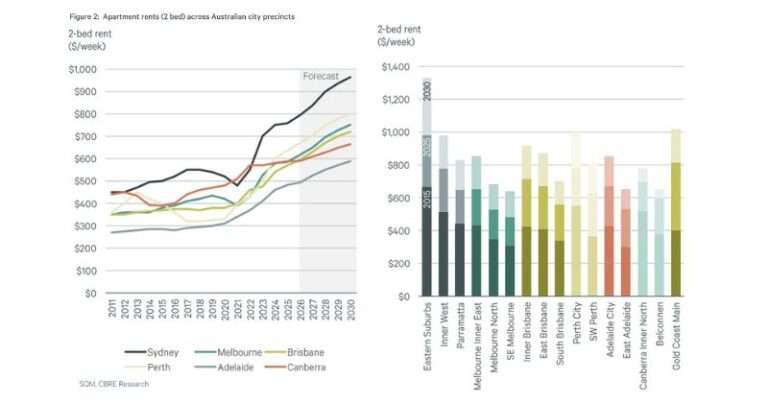
I mean, rents have actually increased according to Charter Cat Cromer’s research.
Since the bottom of the COVID, apartments have increased 42% since then.
The apartment rent, I should say.
And apartment rent can only be increased once every year.
So if you’re coming up for a rent increase now, the rent market rent, when it was set 12 months ago, could be a lot less.
So there’s a lot of owners issuing rent increases, and there’s a lot of tenants receiving them.
And it’s a tricky process.
All right.
What do you do when you receive it as a tenant?
Well, you’ve really got three options, I suppose.
You can pay it, and you need to have given, I think, a couple of months notice, and you’ve got time to take budget for that, so you can pay the rent.
You can move out if you don’t want to pay the rent.
Or you can ring the agent and have a chat to them about it and try and negotiate an outcome.
Okay.
So how does that work?
Because both parties are trying to maximize their benefit, which is just how it works.
If the landlord will ask for a rent increase, what, because they want to make more money or because they have more costs, generally speaking?
Well, I think everyone would say that it’s fair to pay a market rent.
Obviously, working out what that market rent is, is a tricky thing.
An owner has definitely got costs.
They have got increased interest rates.
They have got now land tax, which has increased.
They’ve got compliance costs, which have come in.
Now, cost doesn’t necessarily equal value.
Just because their costs have come up, it doesn’t necessarily mean the market rent has risen, but the market rent has risen.
So an owner would say, well, if I can’t get a commensurate rent, well, it’s not a great investment for me and I’ll sell.
And that’s the worst outcome for renters.
So they’re actually better to get a market rent.
Tenants can pay the rent and the cycle continues, so.
133693, 133693, we’ve got a question.
If you’re a renter or a landlord and you want to talk about rent increases and what your legal rights are and what your obligations are, let’s say I’m renting and you send me an rent increase notice, can I refuse it?
You can, well, look, you can contest it.
I guess the first step I would suggest is you actually ring the agent and have a chat to them about it.
Now, if you got to sort of think back through the process, an owner is not going to or an agent is not going to put up or issue a rent increase above the market because that’s a disaster.
Essentially, the tenants is way above the market.
I’m going to move out into something that is market rent that I can afford.
Then the owner’s got to go through this process of re-leasing it.
They’ve got a vacancy period.
They’ve got leasing fees, advertising costs, and that can actually add up to sort of 10 percent of their annual rent.
So most owners, they look, if the tenant’s looking after the place, they’re doing a good job, they want to look after them, they want to be able to issue a rent increase that’s fair market rent and keeps everybody happy, really.
It’s the benefit of incumbency, as they say.
Okay, so what do you advise, then, if you are involved in, let’s say, a testy negotiation?
Because it essentially becomes a three-way negotiation, doesn’t it, if you’re using the…
The agent.
The agent as a kind of go-between?
Yeah, a conduit.
So, look, I think what has happened, interestingly, is during lower rents, the tenants actually were able to move into properties that perhaps they couldn’t otherwise have been able to afford because the rents dropped so much.
So they’re in a great property, and then the market returns, and the rent returns to the market level.
And the tenants say, well, I can’t no longer afford this.
So either they need to readjust their accommodation standards, more in line with their income, or if they love it and they’re prepared to pay that market rent, then they can pay it.
But it is, I think, a really important element to actually ring the agent and have a discussion with them about it.
Because that agent will actually explain the process a little bit more.
The agents obviously had to issue them with comparable rents, comparable properties, and rents to actually give them a bit of an understanding of what the market rent is.
Jimmy, you’ve got a question for Andrew Wood.
Go ahead.
Oh, hello, yes.
So I had a notice last week that my rent will be increasing, which I can understand.
But in the same notes, it also said that the landlord is going to change my contracts to a month-by-month basis rather than annually, which we’ve had year-by-year.
Now, is that so that in the future they can then increase the rent faster, or how will that affect me and my contract?
Yeah, really good question, Jimmy.
Thanks.
It’s an interesting time for you.
So essentially, a new lease does not necessarily go hand in hand with a rent increase.
So the rent can be increased without offering a new lease.
So basically what the owner is saying, we’d like the rent to go up, but we’re not in a position to offer you a new lease.
That could be for a myriad of reasons.
So essentially, for a new lease, both the tenant and the owner both have to agree.
If a tenant doesn’t want to sign up to a new lease, they don’t have to.
Similarly, if an owner doesn’t want to actually sign up to a new lease, they don’t have to either.
We’ve got many tenants that stay in a property for many years on what’s called a month to month basis.
So they can’t put it up any more than once a year anyway, Jimmy.
There you go.
Good luck.
Good luck, Jimmy.
Tony, good afternoon.
You’re speaking with Andrew Wood.
Go ahead.
Oh, good afternoon.
Curious to get your perspective.
We were broken into over the weekend.
The house was ransacked.
All the locks were damaged.
We called the real estate agent.
He said, no worries.
We’ll get somebody out there.
They sent somebody out.
They’ve now sent us a bill for the locksmith.
Curious to see who’s responsible in this situation, because we would have preferred to have chosen our own locksmith and our own tradespeople to do the work rather than just anyone.
Yeah, I’m sorry to hear that, Tony.
Sounds like a tricky situation for you.
Essentially, if the property has been broken into, the owner should be responsible for fixing the locks, assuming maybe it’s been insured.
But they would normally be responsible for fixing the locks.
As part of keeping the property secure, it wasn’t your fault, obviously.
It does get a little bit marginal.
It depends on, you know, sometimes people lock themselves out and then have to break in.
That’s their responsibility, obviously, to rectify that damage.
But if it’s a third-party break-in, then yeah, not your responsibility.
Where are things at the moment, Tony?
Are you going back and forth, or is it something of a standoff?
Yeah, the agent said it’s our responsibility, and that’s the bottom line that they’re sticking to, which is disappointing for us.
Look, there’s other things like that.
There’s an alarm in the house, which was there when we moved in, but they haven’t given us the code to use, and they’re telling us it’s not working, and they’re not going to fix it.
So at the moment, we’re also going to look at, you know, have we got the option to terminate the lease and move somewhere else, because they’re not being forthcoming.
They also didn’t provide curtains as we requested.
They sort of drag in their heels.
Yeah, look, I’d go to Consumer Affairs, Tony.
The things like blockout blinds, things like basically in a property, if something is there and you’ve inspected it and your assume it works, it needs to work.
So I’d go to Consumer Affairs and get a little bit more information about that, and then go back to your agent, you know, a little bit more armed with some of that detail.
Good on you, Tony.
Be unreasonable.
Pre-chat the call.
133693 if you’d like to give us a call on that.
Before we let you go, anything else you want to leave us that’s top of mind when it comes to rent increases, be you a landlord or a tenant?
Look, I think the only other thing I mentioned, just to be able to speak to the agent, that you’ve got to be given notice to do it.
I think it was an important point that Jimmy raised in relation to a lease and a rent increase not going hand in hand.
I think, importantly, it is important to remember that the rent can only go up once a year, unless you’ve got a longer term lease, so a two or three year lease, and there is no provision within that lease for the rent to increase and the rent can’t increase during that time.
So just reiterating, you either pay the lease.
Look, the other interesting thing, I suppose, Tony, is often an owner will issue a rent increase and will issue it to the tenant and they’ll ring us a couple of weeks later or a week later and say, what did they say?
How did we go?
Did they, you know, they accept it?
Tenant’s not really obliged to accept or reject it.
They’ve got 60 days notice for the rent to go up.
And sometimes they will just start paying the increased rent at that time.
Or, you know, as I said, they’ll give notice to move out or they’ll give us a call and have a chat to try and review the rent.
Andrew, thank you.
And we will see you in a couple of weeks.
That’s Talking Apartments with Andrew Wood from Wood.
Real estate, his family has been in the business for a hundred years.