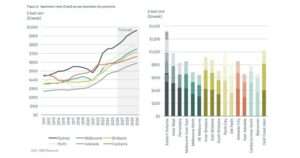
Traditionally the apartment market in each city around Australia moves in a similar way. Each city will have local boom and flat cycles however historically the broader National economic drivers keep the overall longer-term trend similar for each city.
Now it feels like some cities have decoupled from the National trend.
Charter Keck Cramer’s national property research team lead by Richard Tremett is one of Australia’s best. Its latest State of the Apartment Market report paints a complex picture of Australia’s BTS (Build to Sell) and BTR (Build to Rent) apartment market sectors. While all major cities face undersupply and cost challenges, the outlook varies significantly from city to city.
Reviewing the report here’s a city-by-city breakdown.
Melbourne – Undervalued with the most upside
Melbourne’s apartment development market was very difficult in FY2024 but it is now turning the corner.
- Completions of new apartments in FY2025 will be the lowest on record: Just 3,070 BTS apartments, a 50% drop from FY2024.
- BTR leads new supply: 3,444 BTR apartments (53% of total), reflecting a major shift in delivery strategy.
- Demand remains strong: Driven by overseas and returning interstate migrants, attracted by Melbourne’s relative affordability.
Despite high taxes and planning challenges, Melbourne has the greatest price re-rating potential. Prices remain significantly below Sydney and Brisbane, but rents and yields are improving rapidly. As interest rates fall and investor confidence returns, Melbourne is tipped to outperform.
“Melbourne is undervalued and holds the greatest upside of all the cities.” – CKC
Key Metrics:
| Metric | Value |
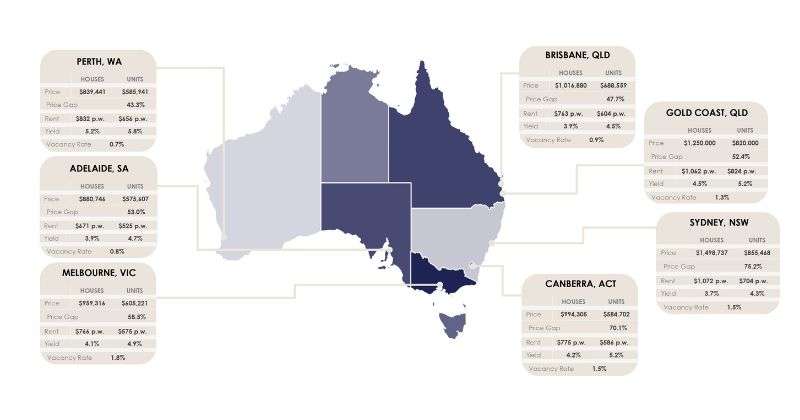
| Median Unit Price | $605,221 |
| Weekly Rent | $575 |
| Yield | 4.9% |
| Vacancy Rate | 1.8% |
| Annual Future Demand | 15,000 pa |
| Forecast Supply (2026-29) | 7,770 pa |
Sydney – Improving but still expensive
Sydney remains the most mature and resilient apartment market, but supply of new apartments still lags behind demand.
- Policy shifts are helping: NSW Government’s planning reforms and financial guarantees are encouraging activity.
- Strong uptake in BTR: 900 new apartment completions in FY2025 – the city’s best year yet.
- Feasibility remains tight: Land and build costs are high; only 21% of apartment supply targets are projected to be met by 2029.
Despite these challenges, Sydney is seeing a positive shift in buyer sentiment, particularly in mid-tier and prestige segments. Infrastructure projects like the Sydney Metro are also driving investment.
Key Metrics:
| Metric | Value |
| Median Unit Price | $855,468 |
| Weekly Rent | $704 |
| Yield | 4.3% |
| Vacancy Rate | 1.5% |
| Annual Future Demand | 35,000 pa |
| Forecast Supply (2026-29) | 7,400 pa |
Brisbane – Supply Risk Ahead of the Olympics
Brisbane has enjoyed a strong run since the pandemic, but storm clouds are gathering.
- Build costs are almost 50% higher than Melbourne, pushing project viability to the brink.
- Industry capacity is maxed out: With Olympic infrastructure and housing targets clashing, developers are struggling to get projects started.
- Major undersupply looms: Forecast shortfall of 7,000+ apartments through to 2029.
While BTS and BTR demand remains robust, the risk of market dislocation is real, particularly between 2028 and 2032 when Olympic construction peaks.
“Brisbane may dislocate like Melbourne due to the shortage of labour and materials.” – CKC
Key Metrics:
| Metric | Value |
| Median Unit Price | $688,559 |
| Weekly Rent | $604 |
| Yield | 4.5% |
| Vacancy Rate | 0.9% |
| Annual Future Demand | 5,500 pa |
| Forecast Supply (2026-29) | 3,720 pa |
Gold Coast – Lifestyle Market Grows Up
The Gold Coast continues to evolve from a boom-bust lifestyle market to a credible, mature housing market.
- Record-high pricing in premium suburbs: Right-sizers and sea-changers dominate buyer demand.
- Apartment completions are strong: Close to twice the historic average expected through 2029.
- Builder shortage remains a constraint: Quality control is key in this design sensitive market.
BTR is still emerging, with four projects expected from 2028 onward. The city’s appeal is undeniable, but delivery risk persists.
Key Metrics:
| Metric | Value |
| Median Unit Price | $820,000 |
| Weekly Rent | $824 |
| Yield | 5.2% |
| Vacancy Rate | 1.3% |
| Annual Future Demand | 2,300 pa |
| Forecast Supply (2026-29) | 2,550 pa |
Adelaide – Quietly Expanding
Adelaide is at an earlier stage in its apartment market evolution, but the signs are encouraging.
- Large projects now more viable: Due to rising house prices.
- BTR interest emerging: One major project approved; more expected.
- Builder shortages persist, limiting supply even as commencements improve.
Completions remain low due to critical labour shortages, but construction commencements hit a six-year high in FY2025. This suggests a pipeline is forming. BTR is also getting noticed, with Adelaide’s first project set for FY2028. However, build quality risk is high, with limited experience in large-scale, high-density product.
With clear support from the SA Government and strong price growth, Adelaide has potential, but capacity and capability constraints could limit how quickly it scales.
Key Metrics:
| Metric | Value |
| Median Unit Price | $575,607 |
| Weekly Rent | $525 |
| Yield | 4.7% |
| Vacancy Rate | 0.8% |
| Annual Future Demand | 1,000pa |
| Forecast Supply (2026-29) | 680 pa |
Perth – High Yields, High Risk
Perth boasts the highest apartment yields in the country but also faces the greatest delivery risks.
- Chronic labour and materials shortages.
- Volatility tied to commodity cycles.
- Growing investor interest, especially in BTR, with 1,300 apartments potentially delivered by 2029.
What’s holding Perth back is simple: capacity. There’s a chronic shortage of qualified builders and contractors capable of delivering high-density stock. While some BTS and BTR projects are in the pipeline, funding and workforce constraints could stall many before they get to site.
The WA Government is backing the sector with incentives, low-interest loans, and skilled migration support, which should help medium-term. But Perth remains more exposed to the commodity cycle and external shocks, meaning volatility is a key risk factor for investors and developers alike.
Key Metrics:
| Metric | Value |
| Median Unit Price | $585,941 |
| Weekly Rent | $656 |
| Yield | 5.8% |
| Vacancy Rate | 0.7% |
| Annual Future Demand | 3,600 pa |
| Forecast Supply (2026-29) | 1,310 pa |
Canberra – Stable and Balanced
Canberra is the closest market to equilibrium in Australia.
- Supply and demand are broadly aligned.
- Completions are rising steadily.
- BTR remains small but is gaining interest due to Canberra’s transient population.
BTR is still emerging in Canberra, but with a high-income, transient workforce and a strong public sector base, the fundamentals are in place for growth. Land release programs and planning support from the ACT Government will continue to ease supply constraints.
The biggest issue is capacity, not just builder numbers, but also the size of the market and number of projects able to scale. Still, with stable demand and a strong local economy, Canberra offers consistency and confidence in a landscape where that’s increasingly rare.
Key Metrics:
| Metric | Value |
| Median Unit Price | $584,702 |
| Weekly Rent | $586 |
| Yield | 5.2% |
| Vacancy Rate | 1.5% |
| Annual Future Demand | 1,400 pa |
| Forecast Supply (2026-29) | 1,230 pa |
Final Thoughts
While all markets face challenges, Melbourne stands out for value, rental strength and re-rating potential. Sydney is resilient but expensive. Brisbane is at risk of overheating. And the Gold Coast is enjoying a high-end boom.
Apartment investors and developers should consider the long-term fundamentals and in particular supply shortfalls, demographic trends and policy tailwinds.
Source: Many thanks to Charter Keck Cramer, State of the Apartment Market H1 2025