
Property investors have always weighed up annual return vs capital growth. More recently, and especially in the apartment market, investors are seeing above average annual return and below average capital growth.
Is that a problem? It is if it upsets your investment objective or personal financial implications like tax.
If you are an ABC news watcher you may have seen Alan Kohler’s report this week on exactly this issue. With his trademark satirical style, he laid bare the issues very simply in 2 minutes. He highlights the problem we all know which is the property investment market has challenges for both investors and tenants. No one is winning. Here are the main points.
Rents are rising fast
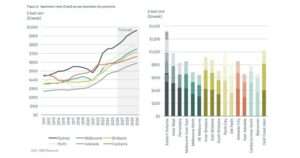
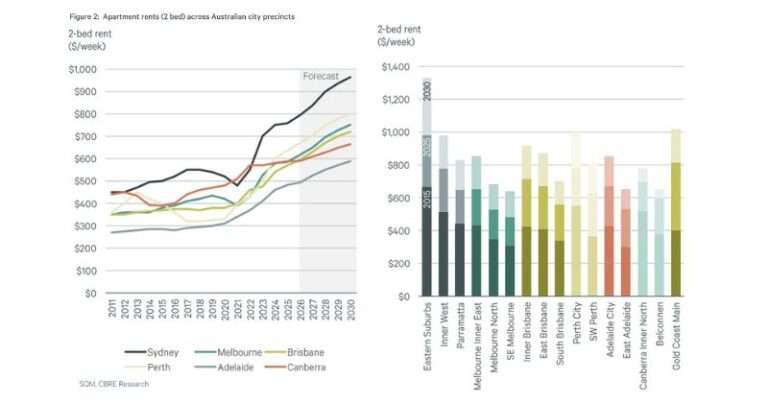
Nationally average weekly rents have climbed by 9.1% p.a. since covid (SQM Research). That’s about 50% over 5 years. So an apartment that was leased for $400/wk in early 2021 now costs $600/wk. Compare that to the historic rental growth rate pre covid of 1.5%.
While holding costs such as compliance rules, land tax and loan cost (if there is debt) have risen, this is a pretty steep rise in investment income.
This is tough on tenants who are trying to save for a house, but good for investment owners and offsets some of the increased costs.
Large fast shocks in the market like this are problematic. They disrupt potential buyers (renters) saving patterns, buying timelines and target locations.
The national average percentage of rent to income is now 33.4% which is the highest it has ever been. This makes it really tricky for someone to pay high rents and save for a home.
Capital market is flat but rising
Unfortunately we don’t need Alan Kohler to tell us the property market has been a bit flat lately. The reasons for this are many, but given all governments are working to make housing more affordable (i.e. mimimal rise in value) there is a general headwind for meaningful capital growth.
Inflation won’t go away (partly due to government spending) which makes construction of new housing more expensive. This retards new supply to levels below the level of demand which is driven by population growth including immigration.
In Canberra, policymakers are acutely focused on housing affordability. The Albanese Government’s commitment to delivering more social and affordable homes including initiatives like the Housing Australia Future Fund, and Help to Buy.
Annual returns
The gross annual yield (income / value) sits at 3.56% nationally. This is not far off bank interest. We know from previous analysis that much higher gross yields of 7% and 8% are being achieved for certain Melbourne apartments.
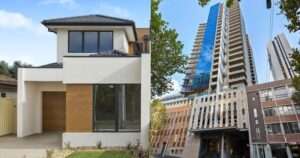
Annual returns vary significantly between houses and apartments and each property’s return generally has an inverse relationship to its capital growth.(ie high annual return -> lower capital growth and visa versa)
2026 Outlook for property investment
Many research houses are still forecasting above average growth in housing generally, KPMG suggest values will rise by 7.7% nationally in 2026. Specifically they forecast Melbourne apartment values will rise by 7.3% and 5.5% in 2026 and 2027 respectively.
Alan Kohler makes the point that if the housing does become more affordable (lower capital growth) then more investors may sell. Less investment properties puts upward pressure on rents (assuming not all buyers are ex renters).
If housing doesn’t become more affordable (i.e. property values rise) which seems more likely, then more renters will be further priced out of the market which is a frustrating situation for them.
Either way the market is adjusting. The historically accepted mix of annual return and capital growth is shifting in different ways for different property types and locations.
Three Signals to Watch in 2026–27
Here are the three key indicators to watch over the next few years.
1. Rental vacancy rates and new supply pipeline
Rental vacancies are the market’s pressure gauge. If vacancies tighten further, rents will continue to outpace inflation. Conversely (but unlikely) if a substantial pipeline of new apartments enter the market it can ease that pressure and temper rent growth.
2. Government policy shifts
Watch for any changes to investment incentives. Especially negative gearing, capital gains tax concessions, or new incentives for build‑to‑rent and affordable housing development. Deminishing the benifits to investors causes a jump in rents.
3. Inflation and interest rates
The RBA demonstrated this week what happens when inflation rises. So do interest rates. Housing is a large componant of inflation. Rent, inflation, wages, and interest rates all feed off (and into) each other. We need to stop the upward spiral.
My prediction
In the short to medium term (12–24 months), I see the following likely developments:
Rents will rise slightly faster than values for most apartments. Driven by sustained demand, population growth, and constrained new supply.
Investor behaviour will shift slightly. Some traditional buy‑and‑hold investors will reassess their strategies if capital growth remains lacklustre. This may encourage more shorter term investors focused on yield / cashflow who may also be trying to pick the capital growth spike timing.
Policy responses will remain iterative, not transformative. Governments will continue to tinker (first home buyer grants, planning reforms, affordable housing funds), but won’t create any dramatic increases in supply, meaning affordability pressures will persist and rents will remain high relative to incomes.